
Publications
Sharing What Works
We’re committed to contributing to the evidence base of what works in engagement and participation. We actively encourage our clients to evaluate their programmes, and we welcome partnerships with independent evaluators who are looking for case studies. You’ll find a few examples shared here, and we’d love to hear from you if you’d like to help us add to the “what works” data.
Blog
We have captured a few thoughts on our blog that you might find interesting.
Social Media
More talking – less posting! That’s us!
We’re not big on promoting our work through social media (you’ll only catch us now and then on LinkedIn). That’s because most of our time is spent where it really matters: in conversations with people, building trust and sparking change.
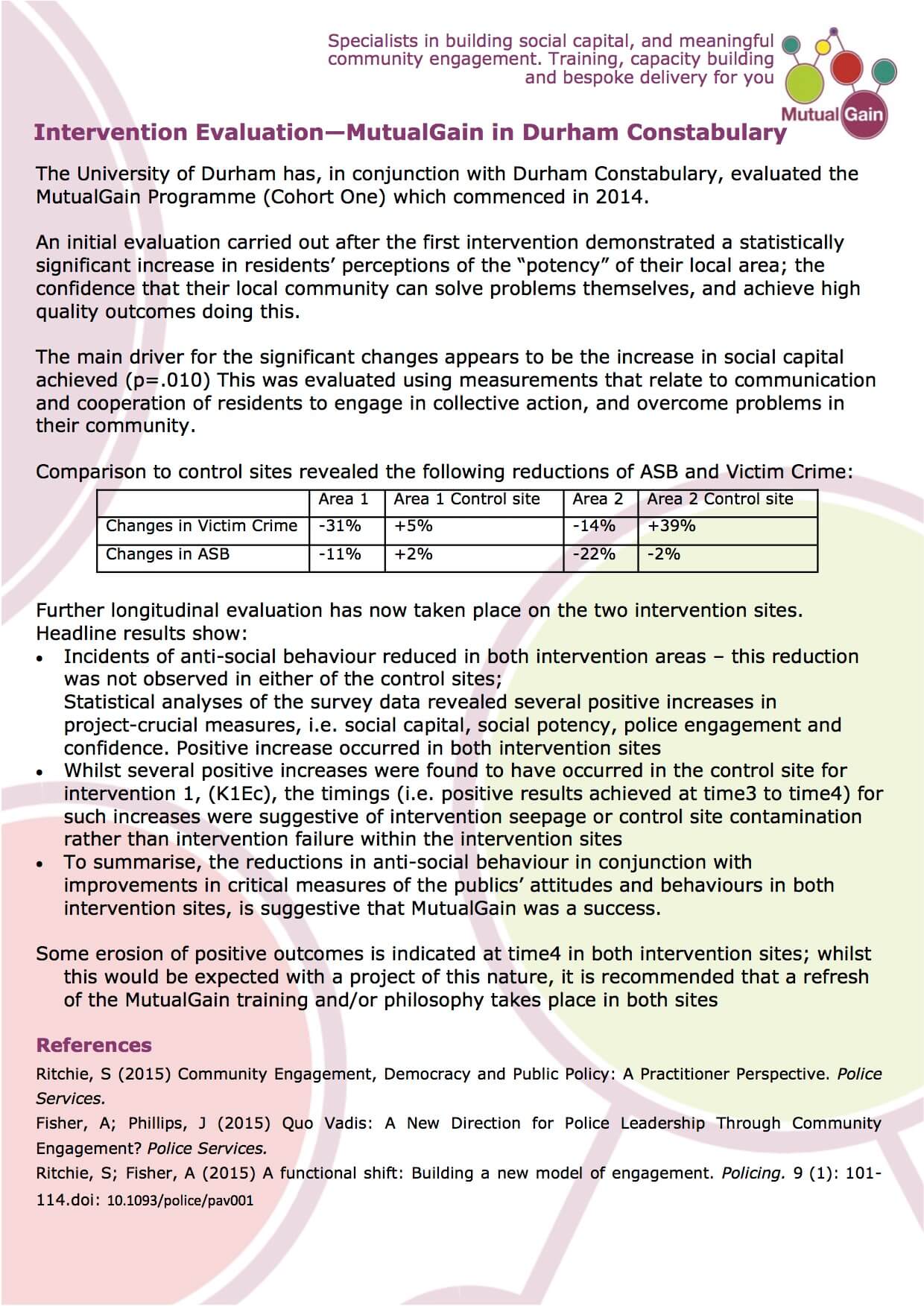
Durham University’s evaluation of MutualGain’s programme with Durham Constabulary
Durham University has, in conjunction with Durham Constabulary, evaluated the MutualGain programme which commenced in 2014.
A summary of the evaluation is included in this short handout from the Excellence in Policing 2016 conference.
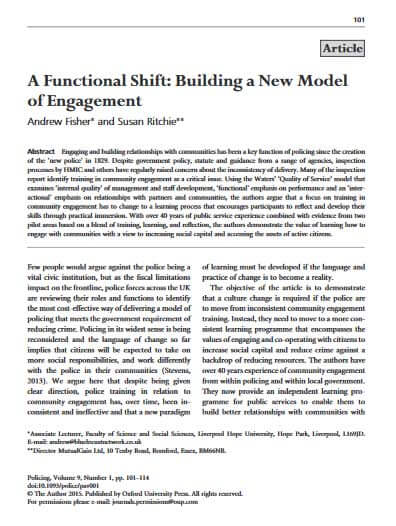
A functional shift. Building a new model of engagement
Engaging and building relationships with communities has been a key function of policing since the creation of the ‘new police’ in 1829. Despite government policy, statute and guidance from a range of agencies, inspection processes by HMIC and others have regularly raised concern about the inconsistency of delivery. Many of the inspection report identify training in community engagement as a critical issue. Using the Waters’ ‘Quality of Service’ model that examines ‘internal quality’ of management and staff development, ‘functional’ emphasis on performance and an ‘inter-actional’ emphasis on relationships with partners and communities, the authors argue that a focus on training in community engagement has to change to a learning process that encourages participants to reflect and develop their skills through practical immersion. With over 40 years of public service experience combined with evidence from two pilot areas based on a blend of training, learning, and reflection, the authors demonstrate the value of learning how to engage with communities with a view to increasing social capital and accessing the assets of active citizens.
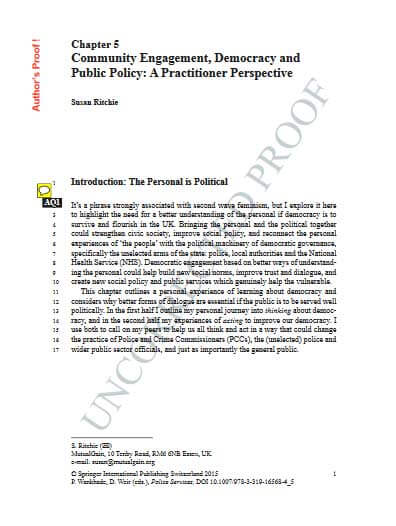
Community Engagement, Democracy and Public Policy: A Practitioner Perspective
The author argues that adopting a deficit model of public service delivery where services ‘fix’ communities rather than build on the strengths they have, is just not working. She provides a personal practitioner’s view of the future of democracy in the UK with particular focus on the way in which public services understand the communities they serve. Going beyond public confidence and satisfaction ratings, Citizens’ Charters, pledges and Local Area Agreements offers the opportunity to reconnect the state with the individual and to re think the feminist phrase of ‘the personal is political’ so that it can be applied to all public services. By developing new skills to listen differently to the communities they serve, public services can act as the enabler of active citizenship to reduce demand and improve social capital.

MutualGain – written evidence to the Citizenship and Civic Engagement Select Committee (CCE0146)
MutualGain thinks about citizenship as relationships and behaviours: how we connect diverse and disparate or conflicting values and behaviours in communities is fundamental to citizenship in a modern democracy. 2. The MutualGain social purpose is to: “empower organisations and communities to reconnect in the social space that lies between the state and the individual. Ultimately, we aim to promote greater participation and active citizenship within our democracy and increase social capital, for the mutual benefit of all. 3. Citizenship for us is about creating spaces for meaningful dialogue and collaborative responsibilities – it goes beyond a managerial or corporate model of engagement (where a token representative or two sits on advisory boards or service user groups) to a model which culminates in increased social capital.